
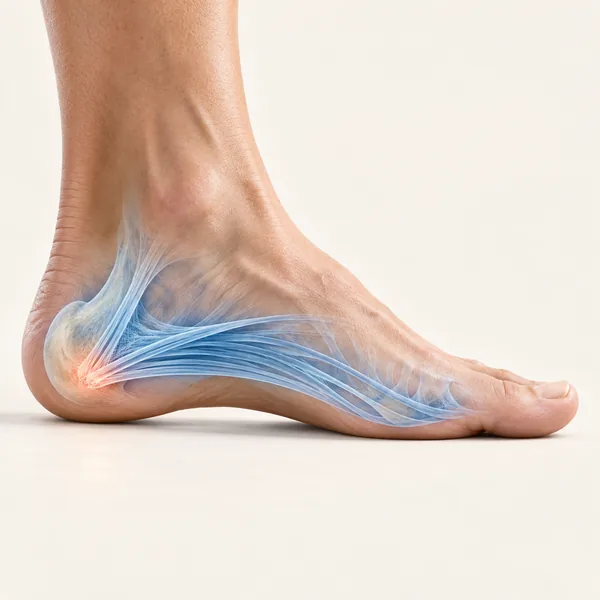
Why heel pain keeps coming back
A scan can confirm that the plantar fascia, the thick band under your foot, is thickened and irritated. That is useful, but it doesn't tell you why the tissue is under so much strain. Without the why, treatment tends to repeat the same steps without lasting progress.
For your foot to work properly, your ankle needs to bend freely. When it can't, because of tension in the muscles and fascia (the connective tissue around them), the foot finds that movement somewhere else, and the heel takes the load.
Where the strain often starts
- Your pelvis: a subtle imbalance can make one leg behave as if it is shorter, building tension through the back and legs.
- Your posture: hours looking down at phones and screens stiffen the upper back, and that stiffness can travel down to lock the ankles.
- Old injuries: an ankle sprain from 20, 30 or 40 years ago can leave a joint quietly guarded and stiff.
- Footwear and load: flimsy or very flat shoes, or a sudden jump in walking or running, add to the strain.
Researchers call this regional interdependence: a problem in one area can drive pain somewhere completely different.
Not all heel pain is plantar fasciitis
Heel pain can also come from irritated nerves around the heel, the heel fat pad, the back of the heel where the Achilles attaches, or a stress fracture. Each needs a different approach, which is why a thorough assessment matters before anything else.
How we help
- A detailed history. Old accidents, falls, sports injuries and what you have already tried.
- A whole-body assessment. Foot structure, ankle movement, pelvis, posture and how you walk.
- Gentle hands-on treatment. Joint mobilisation and fascial techniques to free the ankle and ease tension. No cracking or forceful thrusts.
- Support when it helps. Taping early on, and custom orthotics (insoles made for your feet) once the foot is free to move.
- Your home plan. Simple exercises to keep the improvement going.
Read Iain's article Tried everything for your heel pain? for more on this approach.