
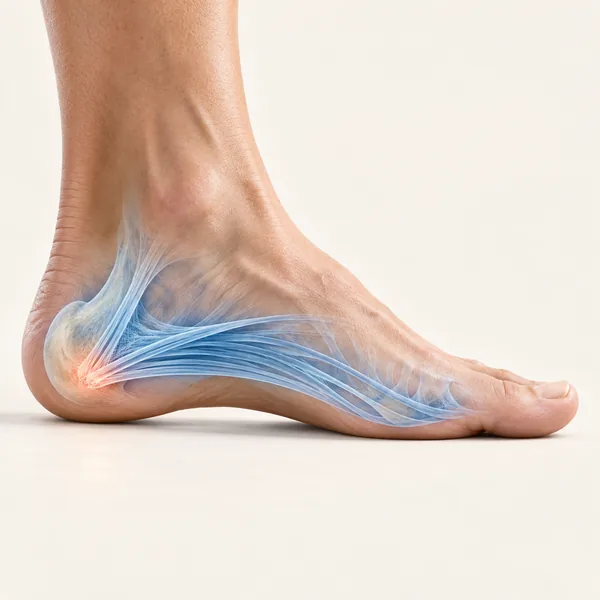
The fascia becomes irritated and can thicken over time. Pain is usually worst with your first steps in the morning or after sitting for a while. Everyday strain keeps irritating it, which slows or stops healing. To get better, you need to reduce that strain and find out where it's coming from.
Long-standing cases are often less about inflammation and more about the tissue struggling to heal. That's why you may also see it called plantar fasciopathy.
Who gets it?
Anyone can develop plantar fasciitis, men and women alike. It's most common between about 40 and 60, and in people who are active or spend long hours on their feet.
What causes it?
There's no single cause. Footwear, high arches, flat feet, a sudden increase in activity, overstretching and body weight can all play a part.
In our experience, though, these factors are rarely the whole story. The real question is why your fascia is under so much strain in the first place. Often the ankle has become stiff, held tight by tension further up the body, in the hips, lower back or posture. Long hours at a desk or on a phone can add to it. When the ankle can't move freely, the foot compensates by flattening, which pulls on the fascia with every step. Old injuries can be part of it too, even a sprained ankle from 20 or 30 years ago.
Not all heel pain comes from the fascia being pulled, either. Some of it comes from irritated nerves around the heel, which needs a different approach. That's why a thorough assessment matters.
The stages of plantar fasciitis
Recent onset. You may feel an ache at the base of your heel, or tightness and pulling along the sole. Some people say it feels like stepping on a stone. This is the best time to act, before it becomes long-standing.
Established. The tightness has become real pain, and it keeps coming back. Your first steps in the morning are very painful, and it can take a while to get going. The pain usually eases as you move, but it returns later in the afternoon or evening after time on your feet, often with tired, aching feet.
Severe. Pain is present for most of the day, and everyday walking becomes a struggle. Many people have had to stop sport or exercise. In some cases, small tears can develop in the fascia. If your heel throbs at rest or wakes you at night, get it checked, because something else may be going on.
How we treat it
Treatment depends on both the stage and the cause.
- Recent onset: self-care, below, and rigid sports taping to support the fascia.
- Established: finding and treating the cause of the strain, then adding orthotics when your foot is ready for them.
- Severe or torn: a period of immobilisation, such as a walking boot, may be needed to let it settle first.
You may have heard of shockwave therapy for heel pain. We don't offer it at Footmech. It helps some people, but it treats the sore spot rather than the reason the fascia is under strain. When that reason is missed, the pain often comes back or never fully settles.
When heel pain drags on, the fascia is usually the victim rather than the cause. We start with a detailed history, including old injuries from years ago. Then we use gentle, hands-on treatment to restore movement and ease tension, and add orthotics only where they'll help.
Many of the patients we see have already tried stretching, injections, shockwave or insoles. If that sounds like you, read Tried Everything for Your Heel Pain? Here's What Might Have Been Missed.
What helps
Self-care has one goal: take the strain off the fascia so it can settle. Some of our advice differs from what you'll read elsewhere online, and we explain why.
Firm-soled, supportive shoes. Choose shoes with a firm sole that doesn't bend too easily at the toes or twist through the middle. A slight heel-to-toe drop also helps, because it eases the pull from your calf onto your heel. Together these limit how much your foot bends and twists, which takes strain off the fascia. Avoid flimsy, flat or zero-drop shoes and flip-flops.
Calf stretches. Tight calves pull on the heel and limit ankle movement, which adds strain to the fascia. Stretch them in two ways: with your back knee straight, then with it slightly bent, to reach both the upper and lower calf muscles. Keep your heel on the floor and hold each stretch gently for about 30 seconds, a few times a day.
Set your foot in a neutral position first. Many people let the foot roll in and flatten as they lean forward. Tilt it slightly towards the outer edge so the arch lifts and the foot isn't collapsed. That keeps the stretch in the calf, where you want it, rather than straining your arch and the fascia. Stretch the calf, not the sole.
Ice in the evening. Wrap an ice pack in a cloth and hold it on the heel and arch for 15 to 20 minutes, at least once every evening. Never put ice directly on your skin.
Rolling, with the right technique. Gently rolling your foot over a frozen water bottle or a ball can ease pain and soreness. Technique matters, though, because pressing too hard or in the wrong place can aggravate it. We'll show you how to do it properly at your appointment.
Orthotics, when they're right for you. Orthotics have a place, but they're not the starting point. If your ankle is stiff or held tight by tension elsewhere in the body, the foot compensates and strains the fascia, and an insole on its own won't change that. We restore movement and ease the tension first, so your feet can accept and benefit from orthotics. Then, if you need them, they help your foot work with better timing and take ongoing strain off the fascia. They support the foot, but they don't fix the cause on their own.
What to avoid while it heals
The fascia is already irritated. Anything that stretches it or heavily loads the sole keeps it aggravated.
Avoid bare feet, even around the house. Hard floors are where many people aggravate their heel without realising. Wear firm-soled slippers or shoes, and keep them by the bed. Before you get up in the morning, warm up your ankles: draw slow circles with each foot, then gently point your foot down and pull it up towards you about ten times. That eases you into those painful first steps.
Avoid beach walking, running, heel raises and pulling your toes back. Soft sand makes your foot sink and flex with every step, so the fascia works much harder. Running puts repeated heavy load through the heel. Heel raises and pulling your toes back both stretch and strain the fascia while it's trying to settle.
You may see plantar fascia stretches, where you pull your toes back, recommended elsewhere, and some research supports them. In over 35 years of practice, we've rarely needed them and often find they aggravate the heel. We'd rather ease the strain on the fascia than keep stretching it.
Avoid activities that load the forefoot or bend the foot. Hills, stairs, squats and ladders all push your weight onto the ball of your foot and bend the toes back, which pulls on the fascia. If you can't avoid stairs, place your whole foot on each step rather than pushing off your toes.
When you walk, drive the movement from your thigh rather than pushing off from your ankle. Lift your knee a little, put your foot down flatter and lift it off earlier, before the toes bend back much. It feels a bit odd at first, but it takes a lot of strain off the fascia with every step.
Avoid quick, stop-start sports such as tennis, squash, netball and Zumba. Sudden pushing off and changes of direction load the forefoot and jolt the fascia.
You don't have to stop exercising, though. Choose activities that keep weight off your feet, such as cycling, swimming or floor work like sit-ups, press-ups and planks. Do press-ups and planks from your knees rather than your toes, and take it easy pushing off the pool wall. Both bend the toes back and pull on the fascia.
Avoid yoga poses that stretch the sole of your foot. Downward dog is the main culprit, but toe squat and lunges with your back toes tucked under do the same. Skip them for now, or keep your back foot flat. Seated, lying and upper-body work are generally fine.
Don't hang your heels off a step or stretch the sole of your foot. Letting your heels drop over the edge of a step pulls the fascia even tighter, which is the last thing an irritated fascia needs.
When to get it checked
Book an assessment if your heel hasn't improved after 4 to 6 weeks of self-care. Come in sooner if you have pain at night or at rest, numbness or tingling, swelling, or pain that started after an injury.